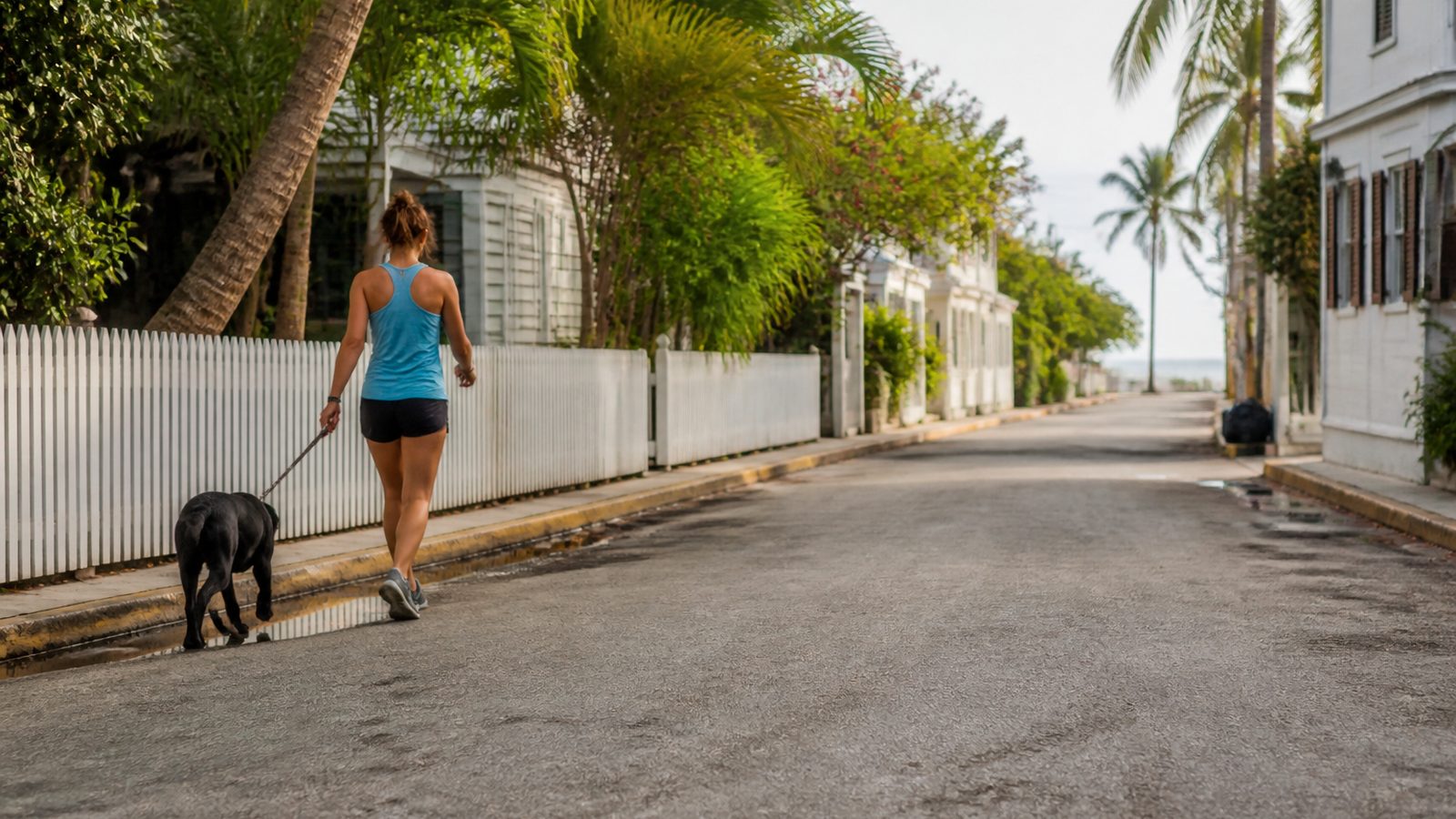

You are walking your dog down a narrow Old Town lane when an iguana cuts across the path. The leash jerks hard, your arm twists, and your next step is more about catching yourself than finishing the walk. In that split second, the whole problem starts with force moving through your hand, wrist, shoulder, or back before you even sort out what happened.
Yes, dog walking injuries are often less about the distance you walked and more about one sudden pull, twist, or stumble. Jason Pirozzolo, DO, a sports medicine physician, keeps the advice simple: "Use a fixed-length, non-retractable leash, approximately 4-6 feet long." He also tells patients, "Never wrap excess leash around the fingers, thumb, hand, or wrist."
What the sudden pull does to your body
Most dog walking injuries begin when force reaches your body faster than you can react. A sprain, meaning an overstretched ligament, or a strain, meaning an overstretched muscle or tendon, can happen in the hand, wrist, shoulder, or back. A fracture, meaning a broken bone, is also common, especially in the fingers and wrist when the leash catches or when you fall on an outstretched hand.
A 2023 study in Medicine and Science in Sports and Exercise estimated 422,659 adult dog walking injuries from 2001 through 2020, and the upper extremity was involved in 51 percent. The same study found 55 percent happened after the walker fell when pulled or tripped. Another study in the American Journal of Emergency Medicine found fractures and sprains or strains were among the most common injuries after leash incidents.
That is why the snap of the leash in the Old Town lane matters more than how routine the walk felt a second earlier. When the leash tightens around a hand or finger, the load gets focused in a small area, and that is where a simple pull can turn into a bigger injury.
When to come in for a visit
Come in if pain, swelling, weakness, or limited motion is still bothering you after the walk or into the next day. You should also be seen if you cannot comfortably grip, lift, turn the wrist, raise the arm, or walk without guarding the sore area.
In the same narrow lane where the iguana set off that sudden pull, the key question is not whether you finished the walk. The question is whether one spot still feels swollen, stiff, or unreliable once the first adrenaline wears off. A 2026 review in Hand looked at 443 outpatient hand and wrist leash injuries, and about 22 percent required surgery, so a lingering hand or wrist problem is worth a proper exam.
Mistakes that make these injuries worse
The most common mistake is wrapping the leash around your fingers, thumb, hand, or wrist to feel more secure. That can trap force in one place and turn a quick yank into a finger, hand, or wrist injury. Dr. Pirozzolo's advice is direct: "Hold the leash across the palm." He also says, "Use wide, flat webbing rather than thin cord."
Another mistake is assuming the leash itself does not matter. A 2026 systematic review in Injury Prevention found pulling was the dominant direct mechanism in 68.5 percent of hand and wrist injuries, and finger fractures were the most common hand or wrist injury. For dogs that pull, a 2025 review found that a well-fitted non-tightening front-clip harness appears to give the best balance between reducing pulling and limiting unwanted effects.
People also tend to shrug off a sore shoulder, jammed finger, or aching low back because the walk seemed short and ordinary. Dr. Pirozzolo keeps the gear advice focused: "Generally avoid retractable leashes, particularly in older adults, patients with osteoporosis, impaired balance, previous falls, or anyone walking a strong/reactive dog."
"The safer setup is a 4-6 ft fixed, wide webbing leash, no retractable mechanism, held entirely in the palm without wrapping, attached to a well-fitted non-tightening front-clip harness if the dog pulls," Dr. Pirozzolo says. Back on that same Old Town lane, the one thing to watch after the jerk is whether one area keeps swelling or stops moving normally once you get home. If you are still dealing with that, have it checked.
If your hand, wrist, shoulder, or back still hurts after that leash snap, especially by the next day, come in and have it checked. To be seen, contact Key West Concierge Orthopedics.
Questions About Dog Walking Injuries
Can a small leash pull really cause a fracture?
Yes. A quick pull can focus force into a finger, wrist, or shoulder, especially if the leash catches around the hand or you fall trying to recover your balance.
Should I stop walking my dog if I feel sore afterward?
Not always, but you should pay attention to pain that stays sharp, swelling that builds, or motion that feels limited the next day. Those are good reasons to be examined.
What setup is simplest if my dog tends to pull?
Dr. Pirozzolo's advice is a fixed leash held in the palm without wrapping. If the dog pulls, a well-fitted non-tightening front-clip harness is a sensible next step.
Sources
- Maxson R et al. Epidemiology of Dog Walking-Related Injuries among Adults Presenting to US Emergency Departments, 2001-2020. Med Sci Sports Exerc. 2023.
- Forrester MB et al. Dog leash-related injuries treated at emergency departments. Am J Emerg Med. 2020.
- Plusch K et al. Hand and Wrist Dog-Leash Injuries in the Outpatient Setting: A Review of 443 Cases. Hand (N Y). 2026.
- Lim B et al. Dog walking-related injuries of the hand and wrist: a systematic review. Inj Prev. 2026.
- Johnson AC et al. Comparing efficacy in reducing pulling and welfare impacts of four types of leash walking equipment. PeerJ. 2024.
- Cavalli C et al. Review of Collars, Harnesses, and Head Collars for Walking Dogs. Animals (Basel). 2025.
Medically reviewed by
Jason Pirozzolo, DO
Fellowship Trained and Board Certified in Sports Medicine
Last medically reviewed: November 1, 2026